... to the more than 200 people who crowded the book launch! I shall be able to upload photos on Wednesday, as tonight I am off to Bangladesh for another film event.
We sold 113 copies of New Malaysian Essays 1 there, 49 copies of Kasut Biru Rubina, and so on ...
A special thanks to Jerome Kugan and Mia Palencia for performing to the standing-room crowd.
It was indeed overwhelming :-)
New Malaysian Essays 1 can now be purchased only at Kinokuniya KLCC (which I am told is displaying it very nicely) and Silverfish in addition to the online store Kinibooks.
Sunday, 17 February 2008


Friday, 15 February 2008
NME1 – now on Kinibooks

The postal pre-orders for New Malaysian Essays 1 have ended! (SFX: Whistle blowing). Thanks to everyone who took part.
Now the book is available online only through Kinibooks, that plucky bookstore run by Malaysiakini.
Wait, there's more! You do have to pay for postage, but each order gets a gift! To find out what the gift is, you will have to click on the link lah.
If you choose not to take the gift (maybe because you already have it), just tell 'em at the Contact Us link.
Or: Just turn up at the launch tomorrow night lor ...
Thursday, 14 February 2008
My life as a typo
Whenever I buy a new book on contemporary Malaysia, the first thing I do is to flip to the index to determine:
1. If it has an index
2. If I am in it
Both are happily true in the case of this compilation by Ooi Kee Beng, the author of that Tun Ismail biography:

Although I am present and accounted for on page 79, my name is misspelled! And the author has even met me before! I hope a reprint can rectify this egregious slip, which even Pak Lah is bound to notice.
Heh.
1. If it has an index
2. If I am in it
Both are happily true in the case of this compilation by Ooi Kee Beng, the author of that Tun Ismail biography:

Although I am present and accounted for on page 79, my name is misspelled! And the author has even met me before! I hope a reprint can rectify this egregious slip, which even Pak Lah is bound to notice.
Heh.
Wednesday, 13 February 2008
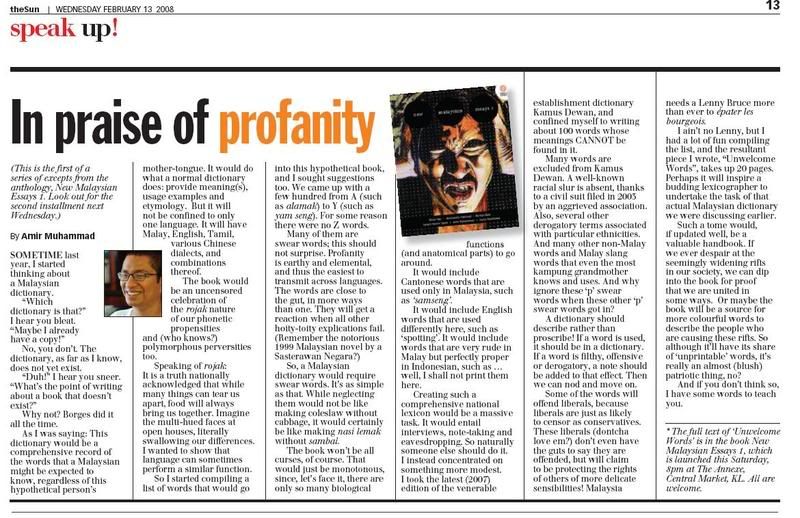
Extracts in The Sun
Starting today, theSun newspaper will run weekly extracts from all of the essays (with the exception of Brian's, which is already printed in Off the Edge).
For my own piece, I chose not an extract. Why not? Because any 900-word continuous stream of words from it would definitely require at least one term that a Malaysian newspaper would need to print with discreet asterisks, such as 'c***i' (which, as a rhetorical strategy, is less effective that 'cibai') or 'ci***' (which would cause unneeded ambiguity, as folks across the land will wonder: Does he mean 'cibai' or 'cipap'?)
So I wrote something new that manages to avoid any such word. The heading now has an extra, and intended, piquancy.

For my own piece, I chose not an extract. Why not? Because any 900-word continuous stream of words from it would definitely require at least one term that a Malaysian newspaper would need to print with discreet asterisks, such as 'c***i' (which, as a rhetorical strategy, is less effective that 'cibai') or 'ci***' (which would cause unneeded ambiguity, as folks across the land will wonder: Does he mean 'cibai' or 'cipap'?)
So I wrote something new that manages to avoid any such word. The heading now has an extra, and intended, piquancy.
Tuesday, 12 February 2008
What will be sold at the launch :-)
Saturday, 16 Feb. 8-10pm. The Annexe, Central Market :-)
Books
NEW MALAYSIAN ESSAYS 1
The first of an annual series of Malaysian non-fiction writing. Featuring Brian Yap, Aminuddin Mahmud, Burhan Baki, Saharil Hasrin Sanin, Amir Muhammad & Sonia Randhawa. Includes drawings, spoof ads and index!
THE OLD HOUSE & OTHER STORIES
The first collection of short stories by Chuah Guat Eng, with themes such as child abuse, greed, hypocrisy and superstition. With an introduction by Professor Quayum!
KASUT BIRU RUBINA: Koleksi Fiksyen Pop Untuk Jiwa2 Hadhari
Himpunan cerpen pop oleh Sufian Abas. Diilhamkan dari konsep sastera pakaibuang (disposable literature) yang dipelopori penulis Yahudi kelahiran Vienna, Herman Broch.
THE BOOK OF SINS
The second book of poetry (and prose) by multi-hyphenate Bernice Chauly is structured loosely around the concept of “The Seven Deadly Sins.’ Oo-er!
IF ONLY
Critically acclaimed debut collection of poetry and drawings by Shahril Nizam. “Fairy tales for grown-ups!” – Sunday Star.
I AM MUSLIM
Bestselling collection of musings and reportage by the hilarious – and sometimes shocking – Dina Zaman.
MALAYSIAN POLITICIANS SAY THE DARNDEST THINGS (Vol 1)
Quote book with self-explanatory title. Compiled by Amir Muhammad with illustrations by Shahril Nizam.
CD:
HARDESH SINGH: Eating Pomeloes from Tokyo to Tamil Nadu Makes My Heart Go Gubra
Cult collection of tunes from Lelaki Komunis Terakhir. Gubra, Tokyo Magic Hour and Chemman Chaalai. Bonus track: the keroncong song from Mukhsin!
Digital music albums:
MIA PALENCIA: Finding My Way
Mia’s debut album will be in stores next month, but here it is in MP3 form. To find out more, listen to her at the launch!
JEROME KUGAN: Songs for a Shadow
Jerome’s debut album will be in stores next month too, but here it is in MP3 form. To find out more, listen to him at the launch!
Books
NEW MALAYSIAN ESSAYS 1
The first of an annual series of Malaysian non-fiction writing. Featuring Brian Yap, Aminuddin Mahmud, Burhan Baki, Saharil Hasrin Sanin, Amir Muhammad & Sonia Randhawa. Includes drawings, spoof ads and index!
THE OLD HOUSE & OTHER STORIES
The first collection of short stories by Chuah Guat Eng, with themes such as child abuse, greed, hypocrisy and superstition. With an introduction by Professor Quayum!
KASUT BIRU RUBINA: Koleksi Fiksyen Pop Untuk Jiwa2 Hadhari
Himpunan cerpen pop oleh Sufian Abas. Diilhamkan dari konsep sastera pakaibuang (disposable literature) yang dipelopori penulis Yahudi kelahiran Vienna, Herman Broch.
THE BOOK OF SINS
The second book of poetry (and prose) by multi-hyphenate Bernice Chauly is structured loosely around the concept of “The Seven Deadly Sins.’ Oo-er!
IF ONLY
Critically acclaimed debut collection of poetry and drawings by Shahril Nizam. “Fairy tales for grown-ups!” – Sunday Star.
I AM MUSLIM
Bestselling collection of musings and reportage by the hilarious – and sometimes shocking – Dina Zaman.
MALAYSIAN POLITICIANS SAY THE DARNDEST THINGS (Vol 1)
Quote book with self-explanatory title. Compiled by Amir Muhammad with illustrations by Shahril Nizam.
CD:
HARDESH SINGH: Eating Pomeloes from Tokyo to Tamil Nadu Makes My Heart Go Gubra
Cult collection of tunes from Lelaki Komunis Terakhir. Gubra, Tokyo Magic Hour and Chemman Chaalai. Bonus track: the keroncong song from Mukhsin!
Digital music albums:
MIA PALENCIA: Finding My Way
Mia’s debut album will be in stores next month, but here it is in MP3 form. To find out more, listen to her at the launch!
JEROME KUGAN: Songs for a Shadow
Jerome’s debut album will be in stores next month too, but here it is in MP3 form. To find out more, listen to him at the launch!
Saturday, 9 February 2008
Is there such a thing as South-East Asian cinema?
Somehow, I don't think this is what we were worried about a few nights ago in Clermont-Ferrand, at a club called Joli Ouah Ouah.

from left: John Torres (The Philippines), myself, Boo Junfeng (Singapore), Chris Chong (Malaysia), Tintin Wulia (Indonesia), Yuni Hadi (Singapore), Edwin (Indonesia), Azharr Rudin (Malaysia) and Emmeline Yong (Singapore). Photo courtesy of Junfeng and taken by John Badalu (Indonesia).
The award ceremony is later tonight! I will be back in KL on Monday.

from left: John Torres (The Philippines), myself, Boo Junfeng (Singapore), Chris Chong (Malaysia), Tintin Wulia (Indonesia), Yuni Hadi (Singapore), Edwin (Indonesia), Azharr Rudin (Malaysia) and Emmeline Yong (Singapore). Photo courtesy of Junfeng and taken by John Badalu (Indonesia).
The award ceremony is later tonight! I will be back in KL on Monday.
Monday, 4 February 2008
Pretty poison
(The second part of my year-long column on old Malay movies, in the February issue of TELL magazine).
In a departure from the fairy-tale atmosphere of previous Malay movies, Racun Dunia (1950) is set in contemporary Singapore. And what a different world it is! Siput Serawak is now a scheming vamp. She’d be called a femme fatale if someone actually died. She smokes cigarettes, swims in a bikini and shouts that she doesn’t care if a child dies – but to be fair, she does not do all these things at the same time.

She has a partner, P. Ramlee, who exudes corruption as an insurance agent. His hair looks like a small oil-slick.
Insurance is an interesting subject, no? Insurance is the reason that Britain never openly declared war against the communists, but instead dubbed it an Emergency. Properties damaged in warfare could not claim insurance for loss of earnings. And quite a bit of property was by now being damaged.
Sir Harold Briggs would be appointed Director of Operation Malaya in March 1950. He had a Plan. True enough, it became known as The Briggs Plan. It involved shepherding the locals, especially Chinese, into heavily guarded New Villages. This is to ensure they could not help the communist guerrillas. Many existing villages were razed to the ground.
But for a happily married urban couple (played by Osman Gumanti and Kasma Booty), life is dolce. They have been together six years. They seem to have it all. But Osman will soon prove that Malay men get that itch a full year before their American counterparts; blame it on the tropical heat.
Siput and Ramlee insinuate their way into Osman’s life, and the poor guy will never be the same. “Kita patut tinggalkan segala yang kolot,” says Siput when they go for a late-night stroll – and boy is he up for it. This terrible twosome entices him into a life of fun while draining him of cash. He leaves his office to go swimming with them, and starts to get really impatient with his whining wife and kid. Why, he even stops wearing his songkok! His father is so aghast that he sputters with rage, sputters some more, and then drops dead – but even that doesn’t deter Osman for long.
Kasma and kid are unceremoniously booted out of the house. But Kasma is such a damp squib – she sounds like she’s whining even when’s she’s not – that you’d need a heart of stone not to laugh at her misery.
Osman, Ramlee and Siput live together and it’s a curious ménage: who’s doing whom? This was way before Jules et Jim! The comical servants disapprove, to no avail.
But it’s the servants, bless ‘em, who ensure that all’s well that ends well.Osman comes to his senses and boots out Siput and Ramlee. But will Kasma take him back?
She not only does, but absolves him of all blame. It’s just the wicked city life that did this to him. “Lupakan saja yang sudah-sudah,” she says in that whine of hers. “Kita bersyukur pada Tuhan.” What a doormat!
Were women really that submissive then? Women were already active in politics and the economy – although there were a few jobs, such as teaching, where they were paid less for equal work.
But then again, look at it from Kasma’s side. It had been only five years since World War 2 and the Japanese Occupation. She would yearn for stability. She’d had enough of air raids, confiscations, and tapioca. She just wanted to get on with life, not be harassed by greedy insurance agents and their hussies. Is that too much to ask?
Racun Dunia plonks itself down in the socio-economic reality of its time; Osman even blames ‘harga getah jatuh’ when he is cash-strapped. The trappings of slick modernity include new-fangled concepts like insurance. Siput even swears in English: “Bloody fool!” she hisses to the maid Siti Tanjung Perak, who is then comically aghast that someone called her a “baldi pool.’”
In the end, the domestic unit is restored and Osman goes back to wearing his songkok. We never see where Siput and Ramlee end up, but it’s safe to say that, like birds scenting carrion, they are circling around their next victim. Ladies, lock up your husbands!
In a departure from the fairy-tale atmosphere of previous Malay movies, Racun Dunia (1950) is set in contemporary Singapore. And what a different world it is! Siput Serawak is now a scheming vamp. She’d be called a femme fatale if someone actually died. She smokes cigarettes, swims in a bikini and shouts that she doesn’t care if a child dies – but to be fair, she does not do all these things at the same time.

She has a partner, P. Ramlee, who exudes corruption as an insurance agent. His hair looks like a small oil-slick.
Insurance is an interesting subject, no? Insurance is the reason that Britain never openly declared war against the communists, but instead dubbed it an Emergency. Properties damaged in warfare could not claim insurance for loss of earnings. And quite a bit of property was by now being damaged.
Sir Harold Briggs would be appointed Director of Operation Malaya in March 1950. He had a Plan. True enough, it became known as The Briggs Plan. It involved shepherding the locals, especially Chinese, into heavily guarded New Villages. This is to ensure they could not help the communist guerrillas. Many existing villages were razed to the ground.
But for a happily married urban couple (played by Osman Gumanti and Kasma Booty), life is dolce. They have been together six years. They seem to have it all. But Osman will soon prove that Malay men get that itch a full year before their American counterparts; blame it on the tropical heat.
Siput and Ramlee insinuate their way into Osman’s life, and the poor guy will never be the same. “Kita patut tinggalkan segala yang kolot,” says Siput when they go for a late-night stroll – and boy is he up for it. This terrible twosome entices him into a life of fun while draining him of cash. He leaves his office to go swimming with them, and starts to get really impatient with his whining wife and kid. Why, he even stops wearing his songkok! His father is so aghast that he sputters with rage, sputters some more, and then drops dead – but even that doesn’t deter Osman for long.
Kasma and kid are unceremoniously booted out of the house. But Kasma is such a damp squib – she sounds like she’s whining even when’s she’s not – that you’d need a heart of stone not to laugh at her misery.
Osman, Ramlee and Siput live together and it’s a curious ménage: who’s doing whom? This was way before Jules et Jim! The comical servants disapprove, to no avail.
But it’s the servants, bless ‘em, who ensure that all’s well that ends well.Osman comes to his senses and boots out Siput and Ramlee. But will Kasma take him back?
She not only does, but absolves him of all blame. It’s just the wicked city life that did this to him. “Lupakan saja yang sudah-sudah,” she says in that whine of hers. “Kita bersyukur pada Tuhan.” What a doormat!
Were women really that submissive then? Women were already active in politics and the economy – although there were a few jobs, such as teaching, where they were paid less for equal work.
But then again, look at it from Kasma’s side. It had been only five years since World War 2 and the Japanese Occupation. She would yearn for stability. She’d had enough of air raids, confiscations, and tapioca. She just wanted to get on with life, not be harassed by greedy insurance agents and their hussies. Is that too much to ask?
Racun Dunia plonks itself down in the socio-economic reality of its time; Osman even blames ‘harga getah jatuh’ when he is cash-strapped. The trappings of slick modernity include new-fangled concepts like insurance. Siput even swears in English: “Bloody fool!” she hisses to the maid Siti Tanjung Perak, who is then comically aghast that someone called her a “baldi pool.’”
In the end, the domestic unit is restored and Osman goes back to wearing his songkok. We never see where Siput and Ramlee end up, but it’s safe to say that, like birds scenting carrion, they are circling around their next victim. Ladies, lock up your husbands!
Subscribe to:
Posts (Atom)